Showing posts with label Travel to Thailand. Show all posts

Thursday, January 16, 2014

Tourist Attraction Places in Thailand

Thailand has an abundant number of beautiful tourist attractions, whether they be spectacular natural attractions such as ultra-fine white sand beaches, beautiful islands in the middle of aquamarine sea, or the splendor of lush forests on verdant mountain range. In addition, there are structures and buildings with gorgeous, historic architectures such as century-old temples, palaces, or quaint neo structure constructions. Those of you who are interested in the historical and cultural sides of Thailand can visit the numerous museums spread all over Bangkok and provinces.

Tourist Attractions
   >> Temple of the Emerald Buddha and The Grand Palace
   >> Jatujak Weekend Market
   >> Pattaya
   >> Koh Larn
   >> Ayutthaya & Ayutthaya Historical Park
   >> Sukhothai
   >> Lopburi
   >> Koh Kret

Temples
   >> Wat Phra Kaew (Temple of the Emerald Buddha)
   >> Wat Pho (Wat Phra Chetuphon Vimonmangkhlararm)
   >> Wat Arun (Temple of Dawn)
   >> Wat Benchamabophit Dusitvanaram
   >> Wat Suthat Thep Wararam
   >> Wat Saket and Phu Khao Thong (Golden mountain)
   >> Wat Ratchanatdaram Woravihara (Loha Prasat)

Museums
   >> National Museum
   >> National Museum of Royal Barges
   >> Rattanakosin Exhibition Hall
   >> Museum Siam
   >> The Jim Thompson House

Floating Markets
   >> Damnoen Saduak Floating Market
   >> Amphawa Floating Market
   >> Taling Chan Floating Market
   >> Tha Kha Floating Market
   >> Don Wai Floating Market
   >> Ayothaya Floating Market
   >> Bang Nampheung Floating Market
   >> Pattaya Floating Market

Night Markets
   >> Khao San Road
   >> Silom & Patpong Night Market
   >> Asiatique
   >> Pak Khlong Talad
   >> Saphan Phut Night Bazaar
   >> Ratchada Night Bazaar

Wednesday, November 13, 2013

Travel to Thailand – Let’s Go to the Sea

I ended my previous blog, When is the Best Season for Traveling to Thailand?, with a promise to recommend to you where and when you can find some beautiful white beaches to sunbathe under clear blue skies. Or if you want to scuba dive in the clear water of the deep sea to look at corals, I can suggest where and when your visit should take place.

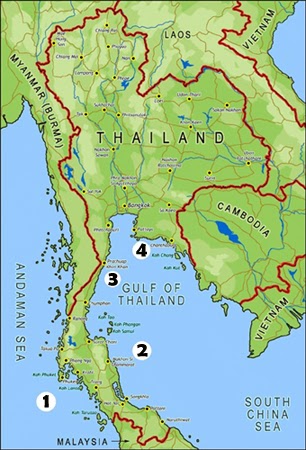
First of all, I must tell you that Thailand is situated in a monsoon climate area; therefore, the influence of the monsoon wind at that period will account for rains or sunshine. That is why I am going to describe the areas with the help of a map in order to give you a clearer picture.


You will notice that the South of Thailand is a peninsula which extends into the sea so that there are numerous beaches and islands in this country, and most of these islands are world-famous; for example, Mahya Bay, Phi Phi Islands, Samui Island, Surin Islands; I’m sure you have heard of some of them. But, where there are seas, naturally there are storms, and mostly when the monsoon season arrives, Thailand will get severe storms. And although our storms are not as ruthless as hurricanes, typhoons or tornadoes, they are nevertheless severe enough to interrupt ferry crossings between the islands and you will certainly agree that being stranded on an island under raging storms and downpours is no laughing matter so let’s find a way to avoid these monsoon winds.

I’m going to split the beach fronts into four parts according to the numbers indicated on the map.
No. 1 means the beaches and islands along the Andaman Sea, such as Patong Beach, Kata Beach, Kamala Beach, Railey Beach, Phranang Beach, Maya Bay, Mu Koh Surin, Mu Koh Similan, Koh Phuket, Koh Phi Phi, Koh Lanta Koh Tachai, Koh Li Pe and Koh Tarutao.
No. 2 covers the beaches and islands around the lower part of the Gulf of Thailand, for example Sairee Beach, Lamai Beach, Koh Tao, Koh Nang-Yuan, Koh Pha-ngan, Koh Samui and Mu Koh Ang Thong.
No. 3 represents the beaches and islands around the upper west coast of the Gulf of Thailand, and covers Hua Hin, Cha-am and Pranburi.
And No. 4 covers the beaches and islands around the upper east coast of the Gulf of Thailand, such as Pattaya Beach, White Sand Beach, Koh Samet, Koh Chang, Koh Larn, Koh Kood, Koh Mak. and Koh Mun Nork.

The most favorable season to vacation by the sea in Thailand is during January to April when you will be able to laze around on every beach both on the Gulf of Thailand side and the Andaman Sea coast. Only from April through mid May would there be heavy winds and high waves at the seashore on the upper part of the Andaman Sea on which are located Surin Islands and Similan Islands due to storms blowing in at intervals from the Bay of Bengal, Indian Ocean.

After that, from mid May onwards enters the southwest monsoon which blows in from the Indian Ocean bringing with it rain clouds from the Andaman Sea into Thailand. This results in all the islands and seashores along the Andaman Sea (No. 1) including the islands and coasts around the upper east part of the Gulf of Thailand (No. 4) being heavily rained upon and there may also be storms so it is not suitable for traveling. Most ferries services to the various islands will stop; however, the seaside around the lower and upper western part (No. 2 and No. 3) of the Gulf of Thailand areas will still be all right for touring as usual if you don’t mind the sporadic seasonal rains because when the rain stops the sky will be clear and sunny, with the months of June and July being the high season along this part of the seaside.

August to September will still be the low season at the seaside along the Andaman Sea (No. 1) and around the upper east section of the Gulf of Thailand (No. 4) as this is still the monsoon season. Furthermore, during these months there will be tropical cyclones moving in from the South China Sea to the Gulf of Thailand, resulting in severe winds and high waves on the upper part of the peninsular on both sides (No. 2 and No. 4) and so water activities or traveling are not advisable during this time. However, it is possible to go to the beaches and the islands around the lower part of the Gulf of Thailand as usual.

Comes October and the southwest monsoon winds begin to lose their force making it possible for us to once again enjoy ourselves at the seaside on the Andaman Sea (No. 1), although rains will fall in profusion on the lower part of the seaside of the Gulf of Thailand (No. 2) due to influence of northeast monsoon winds which bring in some moisture from the Gulf of Thailand. Moreover, there may be some tropical cyclones from the China Sea moving into the sea around this part of the sea which will make it impossible to visit the seaside along that area. However, trips can still be made to some of the seaside on the upper part of the Gulf of Thailand both on the east and west sides because although they also come under the influence of tropical cyclones, these are not as severe as at the lower part of the Gulf of Thailand.

Finally, November and December are the periods when the northeast monsoon winds blow into Thailand. These monsoon winds do not affect seaside traveling along the Andaman Sea and the upper part of the Gulf of Thailand. Only the lower part of the Gulf of Thailand (No. 2) will still be under heavy rainfalls due to the influence of the monsoon winds as well as the influence of the tropical cyclone, causing heavy rains and stormy sea which of course is not advisable for traveling.

All these sketchy weather conditions for the areas around Thailand’s seaside serve as information for your travel planning. Nonetheless, you have to check the weather conditions once again when your traveling date draws near. I hope you will enjoy scuba diving down the bottom of the sea to get acquainted and be fascinated by the schools of fish in the underwater world as well as sunbathing till you tan magnificently on some beautiful beach in Thailand. :-)

Monday, November 11, 2013

When is the Best Season for Traveling to Thailand?

The first thing I usually do when I start planning an overseas trip to any country is to check the best season for traveling to that particular country. (Of course, in case I come across some very inexpensive promotion ticket, I won’t care what kind of weather I will be facing when I get there.) I’m sure nobody wants to waste money and time to travel across the world just to look at downpours through the hotel windows, right? So, let’s see when would be the best season to come or to avoid if you plan to travel to Thailand.

Thailand is situated in Southeast Asia and the overall temperature is hot and humid. It has a tropical monsoon climate with an average temperature of 27°C/81°F. So, if you don’t like sweltering weather with high humidity which makes you feel sticky all the time you should avoid coming to Thailand during the period from August to mid October as this is the middle of the rainy season. Thailand’s rainy season is characterized by its overcast skies and continuous heavy downpours which sometimes last many hours each day and cause floods, or the rain may fall on and off throughout the day. (Thailand’s rainy season starts from mid May and ends around mid October although there may be some rainfalls already at the beginning of May). This is due to the influence of southwest monsoon winds which blow moist air from the Indian Ocean. Apart from the rainy season, there is only the midst of the summertime which may also be a problem for tourists who come from countries with cold climates because Thailand’s summer which begins in mid February and continues until mid May usually has an average temperature of 35°C/95°F which may rise up to 40°C/104°F during March or April, while at the end of summer starting beginning of May there may be short spurts of heavy rains lasting 1-2 hours together with flash-floods, but as soon as the rain stops the weather will be bright and sunny again as usual.

However, if you don’t mind the rain (being well equipped with umbrella and raincoat!!!) and are not afraid of the heat, you may travel in Thailand all year round. But which season is most suitable?? Well, the cool season seems to be most popular with tourists and this season covers the period from the end of October through to mid February or beginning of March. (I don’t think we can actually call this season winter because the weather in Thailand is not cold enough to justify the name.) The cool season temperatures range from approximately 20-30°C/60-86°F due to the influence of northeast monsoon winds which blow in the coolness and the drought from Mongolia and China, resulting in a very short 3-5 days’ cool spell at the end of December in some years at the north and north-east of Thailand which consist of highlands laced with high mountains whose climate is much cooler and of a longer period than at the center plains of the country. However, if luck is with us, some years may see 2-3 weeks of cool climate. On the other hand, as can be expected, cool season can be eliminated from the vocabulary of southern Thailand in view of its close proximity to the equator as well as it being flanked by the seas on both sides so that the temperatures of this region hardly differ at all from season to season. Normally, its cool season is marked by clear skies, cool breeze and strong sunlight... very suitable for people who adore sunbathing on the beach or at hotel’s poolside.

As I already mentioned, the provinces in the South of Thailand have a different climate, and we can in fact say that these areas adjoining the seas have only 2 seasons: wet season and dry season with practically the same temperatures throughout the year. The temperatures are warm and humid as the coasts are sandwiched between the seas, the west coast touching the Andaman Sea and the east coast touching the Gulf of Thailand. The southwest monsoon blowing in during May will bring some rains to the area next to the west coast. And it is fortunate that the South of Thailand is divided in the middle by some mountain ranges, so that the East Coast does not get as much rainfall as the West Coast, with the sun even shining invitingly on some beaches. Alternatively, when the northeast monsoon wind displaces the southeast monsoon wind in November, rain falls on the East Coast next to the Gulf of Thailand enabling us to sunbathe on the West Coast. And with the influence of these monsoon winds, the South of Thailand has much longer rainy season than the inland regions, starting from mid May and lasting through to December.

I hope that the above information can help you make a reasonably good decision on the season to travel to Thailand. The blog which I shall next write about will be a blog for those of you who like the sea or who are beach lovers looking for beaches where you can sunbathe and while away some times on your forthcoming vacation. I dare say that Thailand’s clear blue skies, white beaches, and beautiful islands are second to no other countries in the world. Nevertheless, there are periods which are not suitable for traveling. So let’s see which locations and which periods are worthwhile visiting if you want to sunbathe under a blazing blue sky on fine white sand overlooking a clear turquoise sea where you can acquire some beautiful tan to show off to your envious friends on your return. :-)